

Advanced Phase Change Material Market Set to Surge as Industries Seek Superior Energy Efficiency Solutions 2025-2032
Advanced Phase Change Material Market
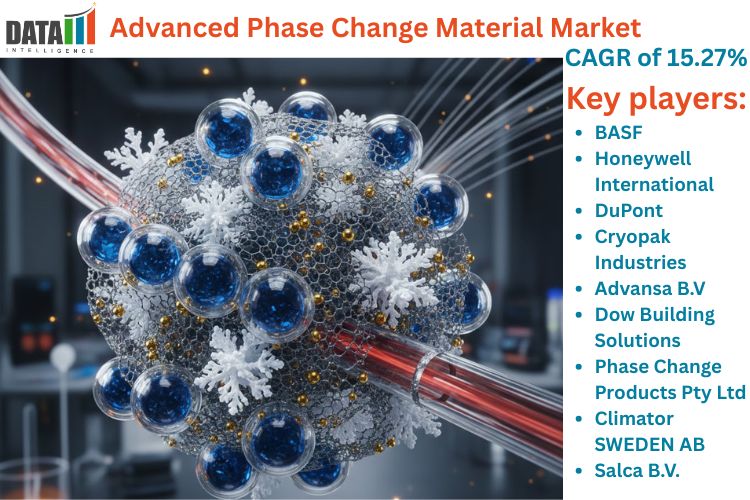
The Global Advanced Phase Change Material Market is expected to reach at a CAGR of 15.27% during the forecast period 2024-2031.
The Advanced Phase Change Material Market is set for robust growth, driven by rising energy efficiency demand, smart buildings, temperature control, and green storage solutions.”
AUSTIN, TX, UNITED STATES, December 18, 2025 /EINPresswire.com/ -- Market Overview:— DataM Intelligence
The Global Advanced Phase Change Material Market is gaining strong momentum as industries continue to shift toward energy-efficient solutions and sustainable building systems. PCMs are widely used for thermal regulation because they absorb, store, and release heat during phase transitions, helping reduce energy consumption and enhance system efficiency. According to DataM Intelligence, The Global Advanced Phase Change Material Market is projected to reach at a CAGR of around 15.27% during the forecast period (2024–2031). Continuous demand for HVAC systems, green buildings, smart textiles, cold-chain packaging, and renewable thermal energy applications is pushing the market forward.
To Download Sample Report Here: https://www.datamintelligence.com/download-sample/advanced-phase-change-material-market
North America currently holds the leading share due to rapid commercial building development, strong adoption of energy-efficient standards, and growing investments in construction technology. Europe follows closely, backed by strict emission regulations and heavy research activities. Meanwhile, bio-based PCMs are emerging as the fastest-growing product segment because of rising environmental concerns and cost-effectiveness compared to traditional paraffin products.
Key Highlights from the Report:
Strong Market growth driven by sustainable construction and rapid HVAC innovation.
Bio-based PCM segment shows the fastest adoption rate due to high eco-compatibility.
North America remains the dominant regional market because of strict energy policies.
Constant technological upgrades in microencapsulation improving PCM efficiency.
Growing PCM integration into electric vehicles, batteries, and EV charging stations.
Major companies investing in R&D and vertical expansion to strengthen portfolios.
Market Segmentation:
The Advanced Phase Change Material Market is segmented by product type, application, encapsulation technology, and end-user.
By product type, the market includes paraffin, salt hydrates, bio-based PCMs, and eutectic materials. Paraffin holds the highest market share due to its availability, excellent thermal stability, and broad temperature range. However, bio-based PCMs are strengthening their presence because they offer minimal toxicity, improved recycling value, and a reduced carbon footprint attributes increasingly demanded by industrial buyers and government bodies.
By application, building & construction remains the leading segment, accounting for a significant revenue share. PCMs are integrated into wallboards, flooring, insulation systems, and roofing materials to stabilize indoor temperatures and lower energy bills. The packaging and cold-chain logistics segment is also gaining importance as pharmaceutical shipments, frozen food transportation, and medical vaccines require strict temperature monitoring.
By end-user, construction, textile, electronics, automotive, aerospace, and energy sectors are primary markets. Automotive applications are rapidly emerging, particularly in electric vehicles, where PCMs help regulate battery temperature, protect against overheating, and extend battery lifecycle. In electronics, PCMs are now common in data centers and semiconductor cooling systems, reducing downtime and boosting performance.
Speak to Our Analyst and Get Customization in the report as per your requirements: https://www.datamintelligence.com/customize/advanced-phase-change-material-market
Regional Insights:
The North American Advanced Phase Change Material Market leads globally due to robust building insulation demand, smart-city infrastructure development, and early PCM product commercialization. Government incentives encouraging high-performance buildings and ongoing investments in sustainable urban design are shaping long-term growth.
In Europe, energy efficiency directives and carbon reduction targets continue to accelerate PCM adoption in HVAC, industrial refrigeration, and cold-chain processes. Germany, France, and the U.K. are major contributors, supported by strong government funding for green building innovation and materials research.
The Asia-Pacific region is projected to deliver the fastest CAGR through 2032. Rising construction spending, rapid industrialization, and growing solar energy storage requirements especially across China, India, and Japan are fueling market expansion. Increasing demand for electric vehicles and cross-border cold supply networks further boost PCM consumption.
Meanwhile, Latin America and the Middle East & Africa are gradually adopting PCMs in building insulation and industrial cooling, supported by rising infrastructure spending and hot climate conditions that increase the need for cost-efficient thermal management.
Market Dynamics:
Market Drivers
The rising demand for energy efficiency across commercial and residential buildings is the strongest driver for PCM usage. Global climate change targets are compelling governments and corporations to reduce energy loss and carbon emissions. PCMs also provide enhanced operational efficiency at lower maintenance, making them a preferred choice in HVAC, industrial manufacturing, electronics cooling, and solar thermal power storage.
The booming electric vehicle and battery manufacturing sector adds further momentum. PCMs can maintain uniform temperatures across battery cells, increasing vehicle range and improving safety. Growth in pharmaceutical cold-chain networks and eco-friendly packaging also contribute to widespread adoption.
Market Restraints
High raw material prices and complex manufacturing remain important barriers. PCM integration demands precise engineering, insulation control, and material compatibility tests, increasing production costs. Some traditional paraffin materials also pose environmental disposal risks, driving regulatory challenges. Adoption may be slower in developing regions where energy-efficient building systems are still emerging.
Market Opportunities
The future PCM landscape holds substantial potential through microencapsulation technology, hybrid thermal batteries, and next-generation bio-based materials. Net-zero building standards and upcoming government mandates are expected to create a massive revenue stream for PCM manufacturers. The integration of PCMs into wearable smart textiles, drones, AI-assisted cooling devices, and future EV battery designs will further widen application scope.
Buy Now & Unlock 360° Market Intelligence: https://www.datamintelligence.com/buy-now-page?report=advanced-phase-change-material-market
Frequently Asked Questions (FAQs):
How big is the Advanced Phase Change Material Market today?
Which region will dominate the Advanced Phase Change Material Market through 2032?
What is the projected market value forecast for 2032?
Who are the leading players operating in the Global Advanced PCM industry?
What key application areas are driving PCM adoption?
Company Insights:
Key companies operating in the Advanced Phase Change Material Market include:
BASF
Honeywell International
DuPont
Cryopak Industries
Advansa B.V
Dow Building Solutions
Phase Change Products Pty Ltd
Climator SWEDEN AB
Salca B.V.
Rubitherm Technologies GmbH
Recent Developments:
United States:
November 2025: The market saw growth from increased adoption in green building certifications under LEED standards, with APCM adoption surging 20% annually, driven by EPA energy efficiency mandates and DOE-funded R&D hubs.
October 2025: Dow Inc. announced plans to expand production capacity for phase change materials to meet rising demand in the renewable energy sector.
September 2025: Construction and cold chain logistics sectors boosted uptake of low- and mid-temperature PCMs, supported by stringent energy codes, infrastructure investments, and collaborations between material scientists and OEMs.
Japan:
November 2025: Integration of AI-driven innovations like predictive analytics and intelligent manufacturing advanced PCM product development, influenced by strict environmental regulations and sustainability mandates.
October 2025: Growth stemmed from high technological adoption in smart building projects and demand for thermal energy storage in commercial refrigeration and HVAC systems, alongside aging population needs in healthcare facilities.
September 2025: Robust expansion occurred due to government energy conservation initiatives, a strong electronics industry, and AI integration for smarter PCM systems, including IoT-enabled modules and miniaturized materials for electronics and automotive uses.
Unlock 360° Market Intelligence with DataM Subscription Services: https://www.datamintelligence.com/reports-subscription
Conclusion:
The Advanced Phase Change Material Market is entering an exciting expansion phase driven by global sustainability directives, breakthrough material innovations, and rapidly growing adoption across construction, packaging, electronics, and vehicle manufacturing sectors. The ability of PCMs to reduce energy consumption and enhance thermal stability is transforming modern engineering design, making them an indispensable component in next-generation technology solutions. With regulatory backing, increasing urbanization, and strong industrial investments, the PCM industry is expected to witness exceptional revenue growth through 2032, redefining the future of energy storage and climate-adaptive infrastructure worldwide.
Related Reports:
Advanced Magnetic Material Market
Thermal Insulation Material Market
Sai Kiran
DataM Intelligence 4Market Research
+1 877-441-4866
Sai.k@datamintelligence.com
Visit us on social media:
LinkedIn
X
Legal Disclaimer:
EIN Presswire provides this news content "as is" without warranty of any kind. We do not accept any responsibility or liability for the accuracy, content, images, videos, licenses, completeness, legality, or reliability of the information contained in this article. If you have any complaints or copyright issues related to this article, kindly contact the author above.
